Knowledge · Construction site & practice
Vapour retarder or vapour barrier (Dampfbremse or Dampfsperre): difference, use and design mistakes
The vapour retarder is rarely the problem, its execution often is. Anyone insulating a roof or wall must know what the membrane is supposed to do and where moisture and air get in anyway.
Last updated 20.10.2026 · 5 min read · Technical rules reproduced in substance, the current text of the standard is authoritative
Key points at a glance
- A Dampfbremse (vapour retarder) and a Dampfsperre (vapour barrier) differ in their sd value, the water-vapour-diffusion-equivalent air layer thickness in metres. In the usual classification: vapour retarder roughly 0.5 m to under 1,500 m, vapour barrier from 1,500 m.
- More important than the name is airtightness. The GEG requires the heat-transferring envelope including the joints to be permanently sealed against air leakage (§ 13 GEG).
- Most damage occurs at junctions, penetrations and joints, not in the open area.
- If you have doubts about the design: notify your concerns in writing before building.
What the layer is for
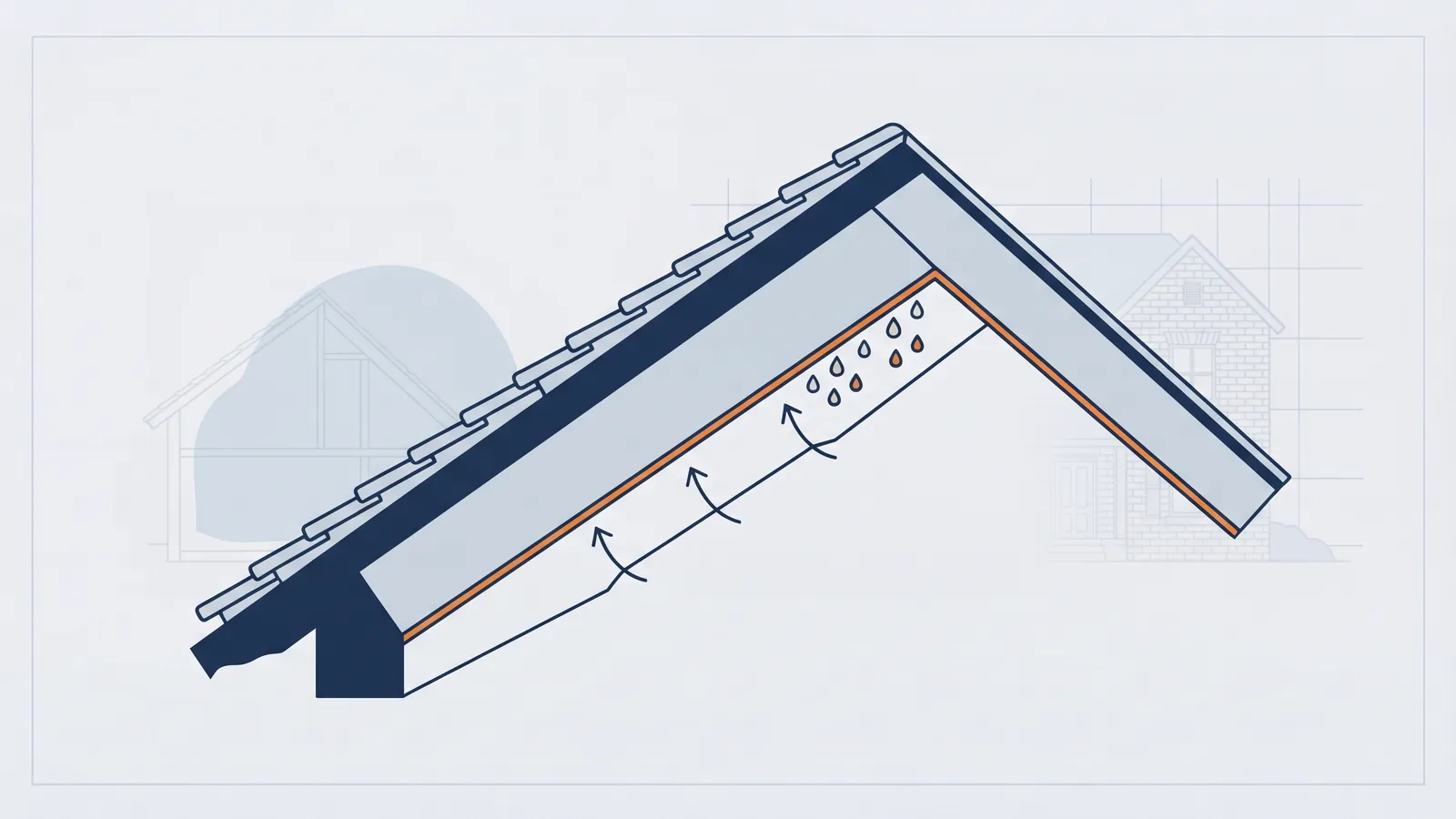
Warm room air contains more moisture than cold outside air. If it gets into the insulation through joints or by diffusion, it can condense there. The consequences are soaked insulation, mould, timber damage and poorer insulation performance. The vapour retarder is meant to do two things:
- Limit diffusion: It lets only a little water vapour through.
- Create airtightness: It prevents moist room air from flowing into the construction through leaks (convection). This is usually the larger moisture input.
What the sd value tells you
The sd value states how thick a still layer of air would be that offers the water vapour the same resistance as the membrane. The higher it is, the tighter the membrane.
| Category | sd value (usual classification) | Examples |
|---|---|---|
| Vapour-open | up to about 0.5 m | Underlay membranes, wood fibre boards |
| Vapour-retarding | about 0.5 m to under 1,500 m | PE or PA films, vapour retarder membranes |
| Vapour-barring | from 1,500 m | Aluminium composite films, bitumen membranes with aluminium insert |
| Humidity-variable | sd value changes with the air humidity | “Smart” vapour retarders |
The exact limits and calculation methods are set out in the relevant DIN standards on moisture protection (DIN 4108-3). Manufacturers’ values apply only within the scope of their approvals and installation instructions.
When a vapour retarder, when a vapour barrier?
A vapour retarder is usually enough for ventilated pitched roofs and for external walls with a vapour-open outer layer. A vapour barrier is chosen when the construction allows no drying out towards the outside, typically unventilated flat roofs (warm roofs) with a vapour-tight waterproofing layer outside. Here a high sd value is needed on the inside, and moisture must not be trapped anywhere.
What matters is the overall system: the layer on the inside should be tighter than the one on the outside. Anyone who chooses a vapour-tight build-up must be able to rule out construction moisture and built-in moisture. Humidity-variable membranes help here, retarding in winter and allowing drying back into the room in summer. Whether that suits an individual case is decided by the building physics calculation.
Airtightness is mandatory
On pitched roofs and in timber construction, the vapour retarder usually forms the airtight layer. § 13 GEG requires the heat-transferring envelope, including the joints, to be sealed permanently against air leakage in accordance with the recognised rules of technology. At the same time, the rules on the required minimum air change remain unaffected: a tight house needs a ventilation concept.
Whether the envelope is tight is shown by an airtightness test (blower door test). Anyone who carries it out before cladding can close leaks with little effort.
Typical execution mistakes
- Membrane not continuous: open joints, missing overlap or unsuitable adhesive tape.
- Junctions forgotten: wall, gable, windows, roof windows and penetrations (pipes, cables, chimney).
- Damage when installing services or battens, for example from staplers, nails and sockets.
- Wrong position: membrane on the cold side or not as the manufacturer specifies.
- Vapour retarder perforated afterwards, for example by lights or cables without sealing sleeves.
- Moisture in the insulation before closing: the build-up traps construction moisture.
- Wrong system in existing buildings: a vapour-tight build-up is placed on an old construction that can only dry towards the inside.
If you retrofit a vapour retarder in a renovation, you must check the drying out of the existing construction. If the component has no way to dry, a humidity-variable membrane is often the better choice, but only after a calculation.
Liability and evidence
The contractor owes a work free of defects in accordance with the recognised rules of technology (§ 13 para. 1 VOB/B). If it follows a faulty plan or the client’s specifications, it is not liable only if it has notified its concerns in writing (§ 13 para. 3, § 4 para. 3 VOB/B). See Bedenkenanmeldung.
Document:
- Design basis: build-up, product, sd value, installation instructions.
- Installation record and photos of the junctions before they are covered.
- Airtightness measurement, if agreed or sensible.
- Approval by the designer or site management before closing.
Check before closing
- Product and sd value match the calculation.
- All joints and junctions bonded with suitable adhesive tapes or sealants.
- Penetrations sealed with sleeves.
- A services layer is provided so that the membrane is not drilled through.
- Timber moisture and insulation dry.
- Photo and measurement record available.
Frequently asked questions
Is a vapour retarder with a high sd value always enough?
Not automatically. What matters is the whole build-up and the airtightness. A high degree of tightness can do harm if moisture is trapped.
Where is the vapour retarder in a pitched roof?
On the room side of the insulation. The position and installation follow from the design and the manufacturer’s instructions.
What is a humidity-variable vapour retarder?
A membrane whose sd value changes with the relative air humidity: higher in winter, lower in summer. This allows moisture to dry towards the inside.
Do I have to carry out an airtightness test after installation?
A tight envelope is required (§ 13 GEG). Whether and how it is tested depends on the contract, funding programme and design. In practice, a measurement before closing makes sense.
Is the tradesperson liable for a wrong design?
Only if they could recognise it and did not notify concerns in writing (§ 13 para. 3 VOB/B).
Sources and status
- § 13 GEG – airtightness (checked against the statutory text in the BauWalker corpus)
- § 13 paras. 1 and 3, § 4 para. 3 VOB/B
- DIN 4108-3 (moisture protection) and DIN 4108-7 (airtightness): not checked word for word here, values and classification reproduced in substance.
- Stand: 19.10.2026. For specific build-ups, a building physics verification is required.
- Quotations of statutory text are given in translation; the German wording is authoritative.
How it works in BauWalker
BauWalker answers questions about technical regulations with the source and separates what is documented from assumptions. For a notice of concerns about the design, it prepares the letter as a draft, and you check the text.
This material is for information and is not legal or tax advice. The specific consequences depend on your contract and the circumstances on the construction site.
Keep reading
Bedenkenanmeldung under § 4 para. 3 VOB/B: when you are liable if you stay silent
When you must raise concerns about the design, instructions, client-supplied material or earlier work, what the notice contains and how it limits your liability.
Mould after renovation: causes, ventilation concept and liability
Why mould appears after window replacement and insulation, when a ventilation concept is needed, how to measure the causes and how to protect yourself as a tradesperson.
German regulations – answers with sources
Questions on VOB/B, BGB and other regulations: the answer cites the source and separates what is verified from assumptions.