Knowledge · Construction site & practice
Renovating old buildings: recognising asbestos and acting correctly (TRGS 519)
In buildings from before the asbestos ban, asbestos in plaster, boards, adhesives and insulation is no exception. Anyone who drills, sands or demolishes without checking risks health and liability.
Last updated 20.10.2026 · 5 min read · GefStoffV and TRGS 519 checked against the text in the BauWalker corpus
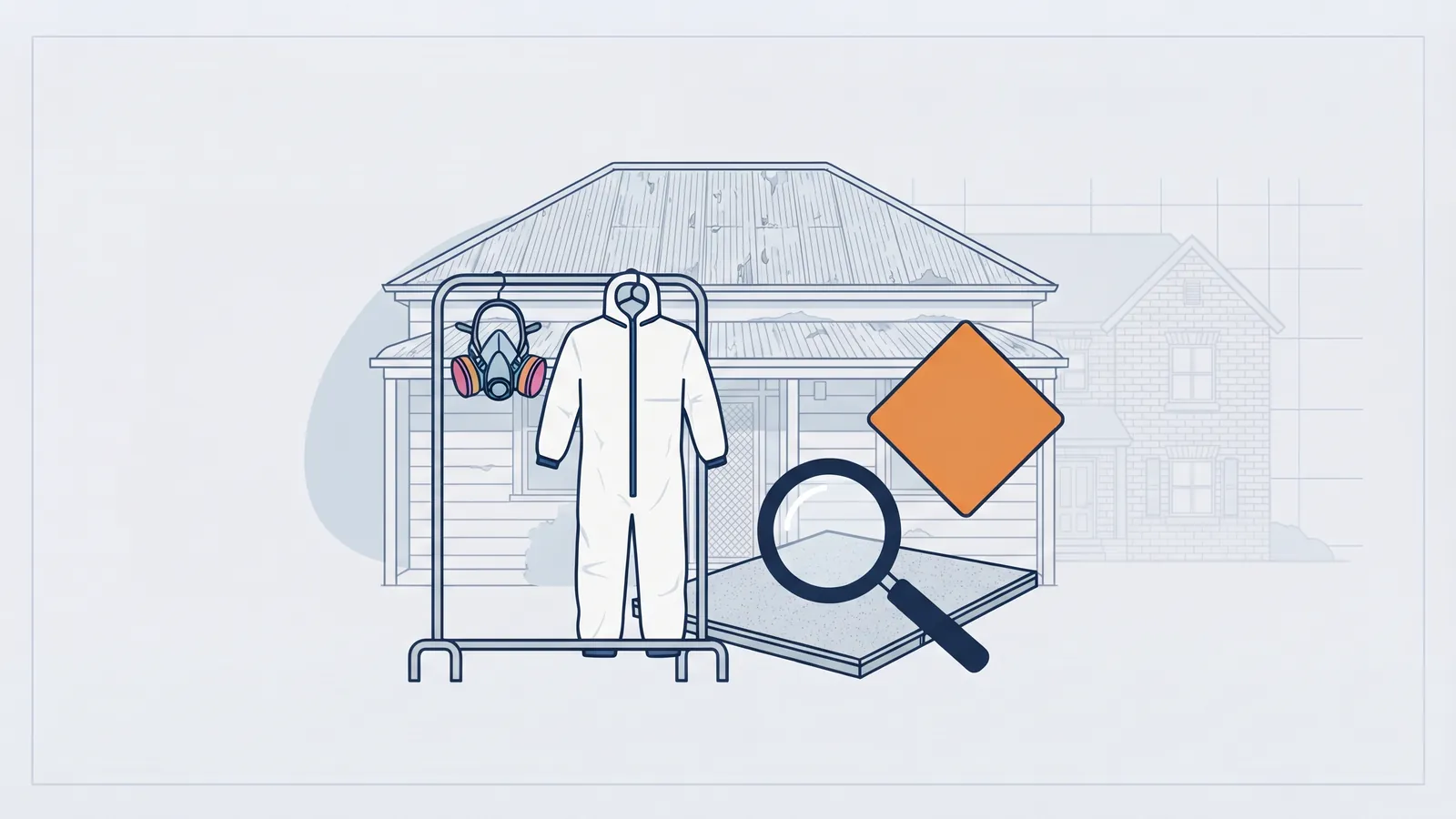
Key points at a glance
- Buildings with a construction year before 1993 are suspected of containing asbestos. For properties from 1993 to 1996, the date when construction started matters (§ 5a GefStoffV).
- The initiator (usually the building owner) must give the contractor all available information on suspected hazardous substances beforehand. This applies to private households too (§ 5a GefStoffV).
- Demolition, renovation and maintenance work (ASI) on materials containing asbestos requires expertise (Sachkunde), which TRGS 519 regulates. The notification to the authority must be made at least 7 days before work starts.
- Suspicion = stop: stop work, secure the area, have a sample taken by a suitable laboratory, inform the client (Auftraggeber) in writing.
- A find can trigger a hindrance and a Nachtrag (change order). Documentation is decisive.
Where asbestos hides in old buildings
For decades, asbestos was used as a durable, fireproof additive. In Germany it has been largely banned since 1993. Typical places to find it:
- Asbestos cement: corrugated sheets and facade panels, roof sheets, flower boxes, waste water and ventilation pipes.
- Floors: vinyl asbestos tiles (“Floor-Flex”), adhesive under floor coverings, levelling compounds.
- Walls and ceilings: plaster, filler, sprayed asbestos (fire protection), lightweight boards.
- Building services: insulation on pipes and boilers, night storage heaters, sealing cords and gaskets.
- Windows: window putty and window sill boards.
TRGS 519 distinguishes two groups, which are decisive for the protective measures:
| Group | Characteristics | Examples |
|---|---|---|
| Firmly bound | Asbestos cement products: asbestos content usually below 15 per cent by weight, bulk density above 1,400 kg/m³ | Corrugated sheets, facade panels |
| Weakly bound | usually bulk density below 1,000 kg/m³ | Sprayed asbestos, lightweight boards, asbestos cardboard, sealing cords |
Weakly bound products release fibres more easily and are therefore much more dangerous.
Who has to know what?
§ 5a GefStoffV obliges the initiator: before the work starts, they must provide the contractor with all the information they have on the construction or use history regarding existing or suspected hazardous substances, in writing or electronically, and for this purpose must make use of the accessible documents. For the asbestos question, this includes the construction year. For properties with a construction year between 1993 and 1996, the date construction started must also be provided. The obligations apply to private households too.
So ask before you submit your quote: construction year? Earlier conversions? Expert reports? And record the answer in writing.
Suspicion on site: what to do?
- Stop work immediately, especially when drilling, sanding, chiselling or demolishing.
- Cordon off the area and keep people away.
- Do not damage it further, no stirring up dust, no vacuuming with ordinary equipment.
- Inform the client in writing (suspicion, location, measure).
- Have a sample taken by a suitable body and analysed. Do not sample it yourself if you are not competent.
- Continue work only after the result and a plan.
Who may remove asbestos?
TRGS 519 applies to demolition, renovation and maintenance work (ASI) involving asbestos. Key points:
- Expertise: The supervisor on site must be qualified (courses under Annexes 3 and 4 of TRGS 519).
- Notification: The work must be notified to the competent authority at least 7 days before it starts. For urgent work, the authority can agree to a shorter period. For construction sites, a notification specific to the property is generally required; for certain cases (low exposure, small-scale work), a company-wide notification is enough, supplemented by place and time.
- Content of the notification: location of the workplace, asbestos products and quantities, activities and methods, number of employees, start and duration, protective measures, place of waste treatment.
- Risk assessment, work plan and operating instructions must be submitted with the notification.
If your business has no expertise, it must not carry out this work. Hire an approved specialist firm and adapt your own work to it.
Contractual consequences of a find
An unexpected asbestos find usually affects time and money:
| Question | Route |
|---|---|
| Delay due to the stop and investigation | Notice of hindrance (Behinderungsanzeige) under § 6 para. 1 VOB/B. The find regularly falls within the client’s sphere of risk if the client did not announce it. See Behinderungsanzeige |
| Extra costs for investigation, protection and disposal | Nachtrag (§ 2 paras. 5 or 6 VOB/B; § 650b, § 650c BGB). Announce it beforehand |
| Concerns about the design or earlier work | Notice of concerns (Bedenkenanmeldung) under § 4 para. 3 VOB/B. See Bedenkenanmeldung |
| Longer interruption | § 6 paras. 5 to 7 VOB/B: settlement of work done so far, termination after 3 months |
Note in the daily report (Bautagesbericht): place of the find, time, measures, people informed. This record will later be your most important evidence.
Practical rules for quotes
- Include a reservation: “Services in connection with hazardous substances are not included.”
- Ask for the construction year and expert reports and record them in the order confirmation.
- Recommend a hazardous substances survey (asbestos, man-made mineral fibres, PAHs) before demolition.
- Disposal only by approved routes. Waste containing asbestos is hazardous and is handled separately.
Frequently asked questions
From which construction year is asbestos suspected?
In buildings with a construction year before 1993. For properties between 1993 and 1996, the date construction started matters, because the ban took effect over transition periods (§ 5a para. 2 GefStoffV).
May I remove an asbestos cement corrugated sheet myself?
Asbestos cement counts as firmly bound. Protective rules of TRGS 519 apply to it as well. For commercial work, expertise is required. Ask the occupational safety authority or a qualified person beforehand.
Do I have to report every find to the authority?
The notification of the work is made before work on material containing asbestos begins (at least 7 days beforehand). Whether and how a chance find has to be reported, clarify with the occupational safety authority.
Who pays for the investigation?
The client, if you did not cause the find and the investigation is not included in the price. Announce it in writing before the investigation.
What is an “initiator”?
Whoever causes work to be done on buildings or technical installations, for example the building owner or property owner (§ 5a GefStoffV).
Sources and status
- § 5a GefStoffV – information duties for initiators (checked against the statutory text in the BauWalker corpus)
- TRGS 519 – Asbestos: demolition, renovation or maintenance work (nos. 2.11, 2.12, 3.2, Annexes 1, 3, 4; January 2014 edition, last amended 2025)
- § 6, § 4 para. 3, § 2 paras. 5 and 6 VOB/B; §§ 650b, 650c BGB
- Stand: 19.10.2026. This article replaces neither a risk assessment nor proof of expertise. The occupational safety authority of your federal state is responsible.
- Quotations of statutory text are given in translation; the German wording is authoritative.
How it works in BauWalker
BauWalker keeps the findings, photos and correspondence of a construction project together in one property file. If you find asbestos, it prepares letters such as the notice of hindrance (Behinderungsanzeige) as drafts, and you check the text.
This material is for information and is not legal or tax advice. The specific consequences depend on your contract and the circumstances on the construction site.
Keep reading
Notice of hindrance (Behinderungsanzeige) under § 6 VOB/B: deadline, content, consequences
When you must give notice of a hindrance, what the notice must contain and which claims to an extension of time and to compensation depend on it.
Bedenkenanmeldung under § 4 para. 3 VOB/B: when you are liable if you stay silent
When you must raise concerns about the design, instructions, client-supplied material or earlier work, what the notice contains and how it limits your liability.
Create documents – invoice, quote, change order
Invoice, quote, change order, letter and acceptance report: you describe the task in your language, BauWalker prepares the document in German.