Knowledge · Money & invoicing
Invoice without VAT: § 13b UStG for construction services (reverse charge)
For construction services to building contractors, you often write an invoice without VAT. That is correct, but only under certain conditions. Anyone who misjudges them risks back payments.
Last updated 20.10.2026 · 5 min read · Provisions checked against the statute and VOB text
Key points at a glance
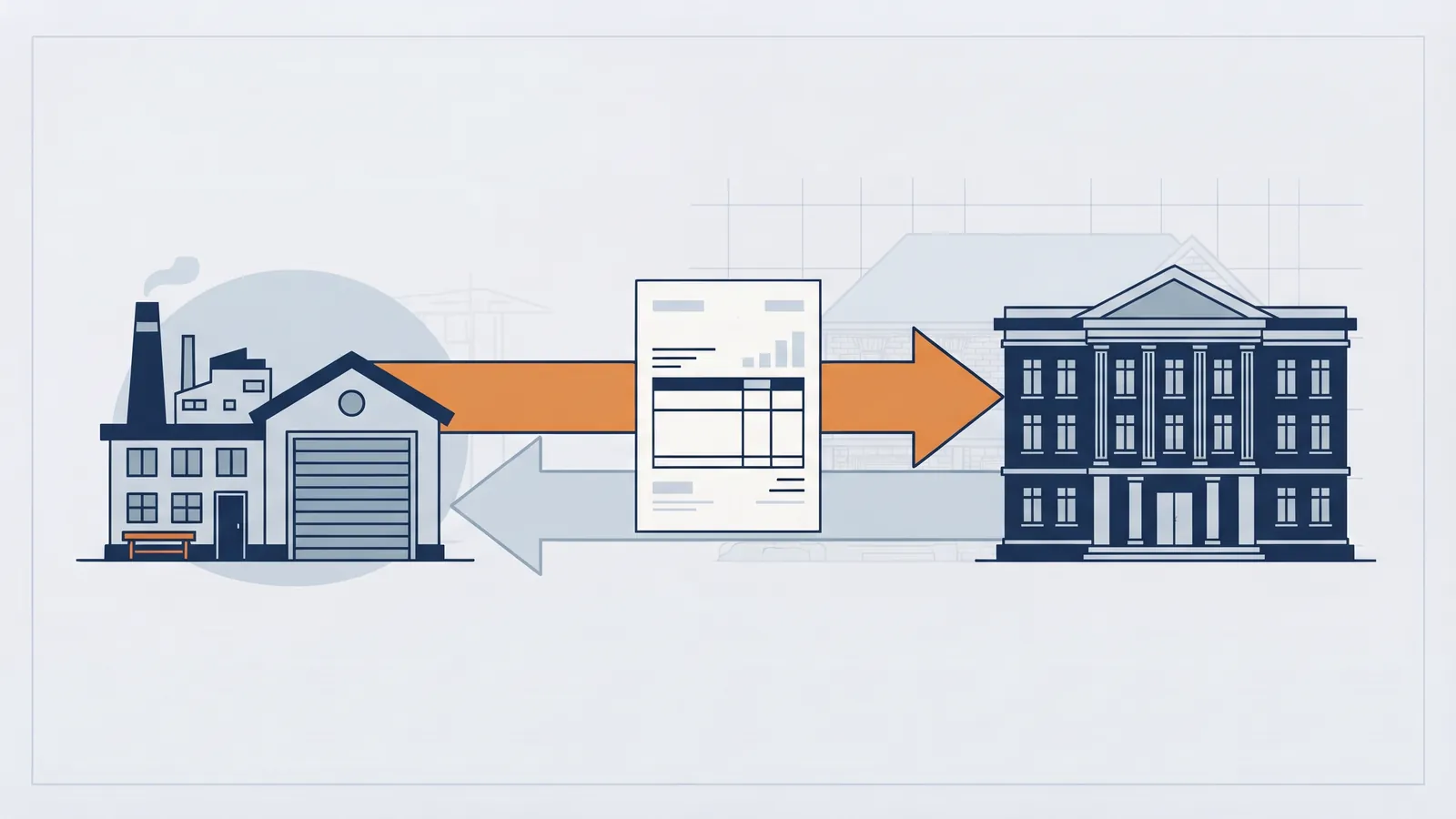
- For construction services, under certain conditions the recipient of the service owes the VAT (§ 13b para. 2 no. 4, para. 5 UStG).
- Condition: it is a business that itself regularly provides construction services. The tax office’s certificate (valid for three years at most) establishes this assumption.
- The invoice contains no VAT and the note “Steuerschuldnerschaft des Leistungsempfängers” (reverse charge: tax liability of the recipient of the service) (§ 14a para. 5 UStG).
- Planning and supervision services are not construction services within the meaning of the provision.
- Private customers and businesses that do not themselves provide construction services continue to receive an invoice with VAT.
What the reverse charge means
Normally the supplying business owes the VAT: it shows it in the invoice and pays it to the tax office. Under § 13b UStG this is reversed: the recipient of the service owes the tax. It pays it over and can usually deduct it at the same time as input tax. For you as contractor (Auftragnehmer), this means: invoice net, without a separate statement of tax.
Which services are affected?
§ 13b para. 2 no. 4 UStG names construction services, including supplies of work and materials and other services in connection with land that serve to produce, repair, maintain, alter or remove buildings, with the exception of planning and supervision services.
Things, fittings and machines that are permanently installed in a building or structure and cannot be moved without destroying or altering the building also count as land.
Who must owe the tax?
Under § 13b para. 5 sentence 2 UStG, the recipient of the service owes the tax if it is a business that regularly provides corresponding services. It does not matter whether it uses the specific service for a construction service of its own.
As proof: “This is to be assumed if the competent tax office has issued it a certificate valid at the time the transaction was carried out and limited to three years at most.” As contractor, you should ask the customer for this certificate before issuing the invoice and file it in the project folder.
In the view of the tax authorities, a business provides construction services on a sustained basis at least when they make up at least 10 per cent of its worldwide turnover (section 13b.3 UStAE). Anyone who holds such a certificate from the tax office (form USt 1 TG) owes the tax as recipient of the service, on this view, even if they do not show it to the supplier. The current decree is authoritative; clarify the details with your tax adviser.
| Customer | Invoice |
|---|---|
| Building contractor that itself provides construction services (certificate available) | without VAT, with reference to § 13b |
| Landlord, trading company without construction services of its own | with VAT |
| Private person | with VAT |
| Public sector | depends on whether it obtains the service for its non-business sphere (§ 13b para. 5): then it does not owe the tax |
What must be in the invoice
If the business carries out a service under § 13b para. 2 for which the recipient owes the tax, it is obliged under § 14a para. 5 UStG to issue an invoice with the statement “Steuerschuldnerschaft des Leistungsempfängers”. The separate statement of tax (§ 14 para. 4 sentence 1 no. 8 UStG) then falls away.
The general mandatory details also apply: names and addresses, tax number or VAT ID number, period of the service, net amount, invoice number and date.
When the tax arises is governed by § 13b para. 2: on issue of the invoice, at the latest at the end of the calendar month following performance of the service. Under para. 4, this also applies to partial payments already received before performance (interim payments).
When both are mistaken
§ 13b para. 5 UStG contains a protective rule: if the recipient of the service and the supplying business, in cases of doubt, both assumed that the conditions were met, although this was objectively not correct given the nature of the transactions, the recipient is nevertheless deemed to be the taxable person, provided this causes no loss of tax. This is not an invitation to guess: anyone who knows the conditions must check them.
How § 13b affects retention and construction withholding tax
- Security retention (Sicherheitseinbehalt): For invoices without VAT under § 13b, the VAT is disregarded when calculating the retention (§ 17 para. 6 no. 1 VOB/B). See Security retention and surety bond.
- Construction withholding tax: applies in addition and independently if the conditions are met. See Construction withholding tax.
Typical mistakes
- Invoice without VAT to a private customer or a business without construction services of its own.
- No proof: the customer’s certificate is missing, the assumption is unsupported.
- Note forgotten: “Steuerschuldnerschaft des Leistungsempfängers” is missing.
- Mixed invoice: construction service and supply in one invoice without a clear separation.
- Abschlagsrechnung (interim invoice) still with VAT, Schlussrechnung (final invoice) without.
Frequently asked questions
Does § 13b also apply to repairs and small orders?
Yes, if they are construction services within the meaning of the provision (including repair and maintenance of buildings). § 13b contains no de minimis limit.
May I show the VAT anyway?
In § 13b cases, the recipient of the service owes the tax. If you nevertheless show it separately although you are not entitled to do so, § 14c UStG can mean that you yourself owe the amount shown. Clarify this beforehand with your tax adviser.
What happens with photovoltaics and insulation?
That depends on the individual case, for example whether the system is permanently connected to the building. There are separate administrative rules for this. Have such cases checked for tax purposes.
Do I have to keep the customer’s certificate?
Recommended: yes. It proves that the customer is the taxable person. Check validity and date.
Who files the tax?
The recipient of the service, in its advance VAT return. Your service appears with you as a turnover for which the recipient owes the tax.
Sources and status
- § 13b UStG – recipient of the service as taxable person (checked against the statutory text in the BauWalker corpus)
- § 14a para. 5 UStG – additional duties when issuing invoices
- § 17 para. 6 no. 1 VOB/B – provision of security
- § 14c UStG – incorrect or unauthorised statement of tax (checked against the statutory text in the BauWalker corpus)
- Section 13b.3 UStAE (threshold of 10 per cent of worldwide turnover, binding effect of the certificate): reproduced from published excerpts, not checked against the current wording. Property developers (Bauträger) are a disputed special case (case law of the BFH deviating from the administration) and are not covered here.
- Stand: 19.10.2026. For tax purposes, only advice in the individual case is binding.
- Quotations of statutory text are given in translation; the German wording is authoritative.
How it works in BauWalker
BauWalker prepares invoices as drafts. Whether § 13b UStG applies in an individual case, you clarify with your tax adviser. The program does not replace tax advice.
This material is for information and is not legal or tax advice. The specific consequences depend on your contract and the circumstances on the construction site.
Keep reading
Schlussrechnung (final invoice) under VOB/B: deadline, verifiability, payment
By when the final invoice must go out, what verifiable means, when the money falls due and how the reservation on final payment works.
Construction withholding tax and the exemption certificate under § 48 EStG
Who has to withhold 15 per cent, which de minimis limits apply, how the exemption certificate (Freistellungsbescheinigung) protects you and which deadlines apply for the filing.
Create documents – invoice, quote, change order
Invoice, quote, change order, letter and acceptance report: you describe the task in your language, BauWalker prepares the document in German.